While the Mondays of the holy month of Shravan (Sawan) are universally dedicated to Lord Shiva, the Tuesdays belong to his divine consort, Mata Parvati, worshipped in her benevolent form as Mangala Gauri.
The word Mangala signifies auspiciousness, grace, and wellbeing, while Gauri represents the radiant, nurturing aspect of Goddess Parvati. Observed primarily by married and newly married women, Mangala Gauri Vrat is a sacred vow taken to invoke long life for one’s spouse, marital harmony, domestic prosperity, and deep emotional alignment within relationships.
Whether you are carrying forward a cherished family tradition or embracing this ritual for the first time, here is your complete guide to observing Mangala Gauri Vrat in August 2026.
🗓️ Mangala Gauri Vrat Dates for August 2026
The exact observation dates vary depending on whether your regional traditions follow the Purnimanta calendar (predominant in North India) or the Amanta calendar (followed in Maharashtra, Gujarat, and South India).
North India (Purnimanta Calendar)
(Uttar Pradesh, Rajasthan, Madhya Pradesh, Bihar, Punjab, Delhi, etc.)
- 1st Mangala Gauri Vrat: Tuesday, August 4, 2026
- 2nd Mangala Gauri Vrat: Tuesday, August 11, 2026
- 3rd Mangala Gauri Vrat: Tuesday, August 18, 2026
- 4th Mangala Gauri Vrat: Tuesday, August 25, 2026
West & South India (Amanta Calendar)
(Maharashtra, Gujarat, Goa, Karnataka, Andhra Pradesh, Telangana, Tamil Nadu)
- 1st Mangala Gauri Vrat: Tuesday, August 18, 2026
- 2nd Mangala Gauri Vrat: Tuesday, August 25, 2026
- 3rd Mangala Gauri Vrat: Tuesday, September 1, 2026
- 4th Mangala Gauri Vrat: Tuesday, September 8, 2026
🌸 Significance: The Divine Symbolism of Mangala Gauri
According to Hindu tradition, Goddess Parvati underwent rigorous penance (Tapasya) to win Lord Shiva as her consort. Her devotion symbolizes patience, resilience, and unshakeable inner commitment.
When women observe the Mangala Gauri Vrat, they channel this exact divine feminine energy (Shakti). The fast is believed to:
- Neutralize Marital Friction: Smooth out misunderstandings and build deeper mutual respect.
- Remove Obstacles (Mangal Dosha Mitigation): Mitigate astrologically challenging alignments related to Mars (Mangal).
- Bless the Household: Bring peace, longevity, health, and joy to the immediate family.
🕯️ Step-by-Step Puja Vidhi (How to Perform the Rituals)
Performing the Mangala Gauri Puja at home is simple and deeply grounding.
1. Morning Preparation
- Wake up early during Brahma Muhurta, take a bath, and dress in traditional attire (shades of red, yellow, or green are considered auspicious; black is strictly avoided).
- Clean your altar area and purify the space with a sprinkle of water or Gangajal.
- Take a quiet pledge (Sankalpa) in front of the divine space, resolving to fast with devotion and pure intent.
2. Setting the Altar
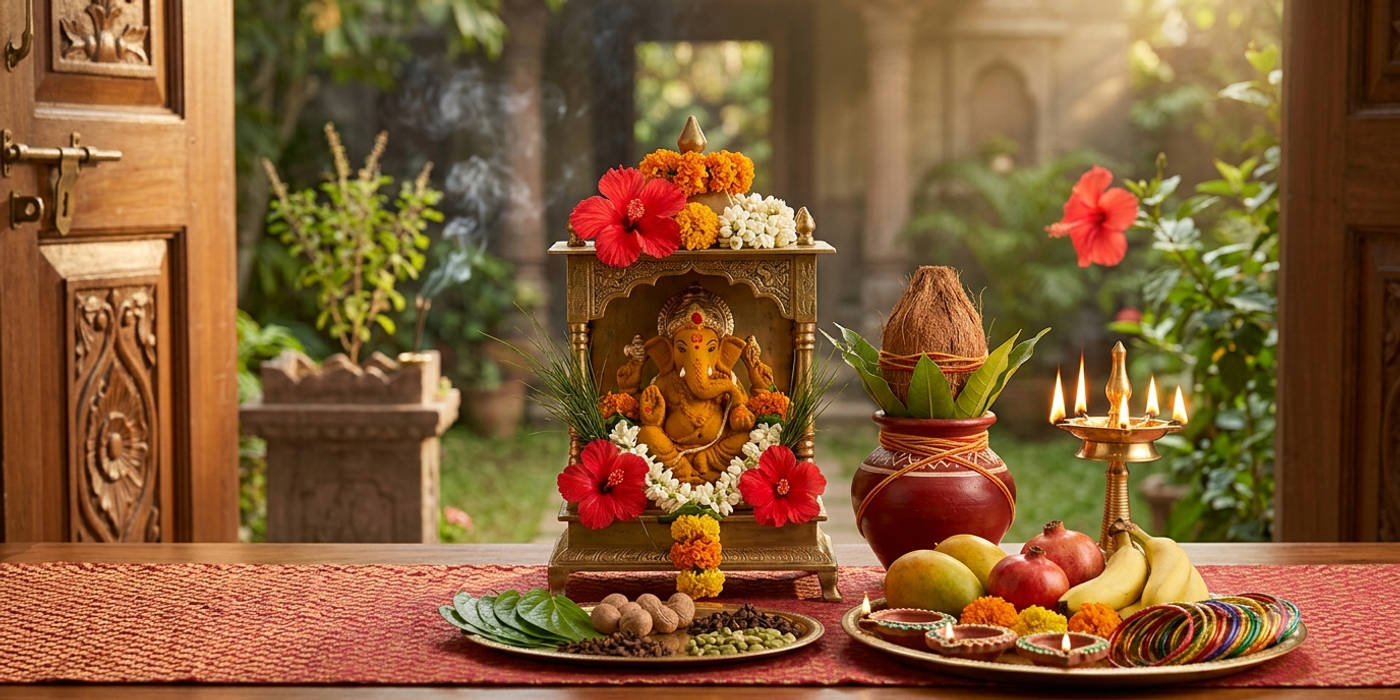
- Cover a small wooden stool (Chowki) with a clean red cloth.
- Place an image or idol of Goddess Parvati and Lord Shiva. Traditionally, a small idol of Mangala Gauri is also crafted using clean clay or turmeric paste.
- Light a ghee lamp (diya)—a four-wick lamp (Choumukhi Diya) prepared from wheat flour is traditional for this vrat.
3. Offerings & 16-Shringar
Because 16 is a sacred number associated with Goddess Gauri, traditional offerings are presented in sets of 16:
- 16 Solah Shringar Items: Turmeric, kumkum, vermilion (sindoor), red glass bangles, bindi, nose ring, henna (mehndi), saree, etc.
- 16 Offerings: 16 betel leaves, 16 nuts (supari), 16 cloves, 16 cardamom pods, 16 flowers, and 16 fruits.
4. Chanting & Vrat Katha
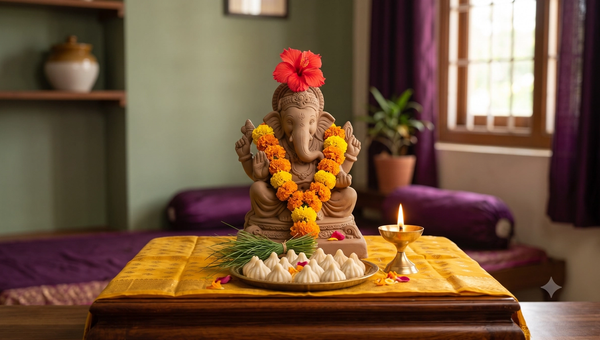
- Begin by offering prayers to Lord Ganesha to ensure a smooth, obstacle-free ceremony.
- Recite or listen to the Mangala Gauri Vrat Katha (the sacred story detailing how the blessings of Goddess Gauri grant long life and protection against fate).
- Chant the sacred mantra 108 times:
ॐ मंगला गौर्ये नमः
(Om Mangala Gauryai Namah)
5. Fasting Rules & Evening Arati
- Fasting: Most devotees observe a fruit/liquid fast (Falahar) throughout the day or consume one Sattvic meal after concluding the evening rituals.
- Perform the Aarti in the evening, offer homemade sweets (Modak, Puran Poli, or Laddoo) as Prasad, and break your fast with pure, simple food.